
How Arrest Warrants Work in Scott County
Iowa keeps the sequence strict. Under Iowa Code section 804.1, a magistrate may issue an arrest warrant only after a complaint and a supporting affidavit lay out probable cause. That standard is modest but real. It means a reasonable factual basis exists to think an offense happened and that the named person committed it. The Scott County Sheriff's legal-procedure order follows the same logic, describing written facts sworn to a neutral and detached judge. Not every case needs a warrant, though. A citation can replace an arrest when Iowa law allows it, and an indictment or information can also lead to a warrant under Iowa Court Rule 2.36. Whichever route applies, a judge reviews first and the arrest power follows. The Clerk then files the order and the case record. From there, an authorized peace officer executes the warrant within the law. That is also why a Scott County Sheriff web result and the court's signed process are related documents but never the same thing.
Scott County Arrest Warrant Probable Cause
The local path can be read as a chain: allegation or charging paper → sworn factual support → neutral judicial review → signed warrant → Clerk filing → transfer to law enforcement → service and return. The Sheriff’s general order says a deputy files a warrant with the Clerk at once, or on the next work day when it is obtained after hours or on a weekend. After execution, the warrant returns to the Clerk with service recorded.
This process also draws firm lines between roles. A Scott County deputy or city officer can supply facts and execute process. Neither one makes the probable-cause call; that belongs to the judge alone. The Clerk maintains the record and routes it, but decides nothing. A Scott County arrest warrant lookup works best when each office stays in its lane, and no single public webpage should be treated as the full official record.
Key point: An arrest warrant records judicial authority to arrest on an accusation; it does not record a conviction or final case result.
Arrest Warrants: What They Contain
What goes on the paper matters too. Iowa Code sections 804.2 and 804.3 govern the warrant's required content and the bond endorsement. The public Sheriff schema shows only selected fields. Treat a warrant number, issue date, charge text, bond, and status as identifiers for a clerk check in Scott County. Read no more into a row than it shows, and never assume the public bond value still controls.
| Warrant number | An agency identifier used to trace the process; no single local format was established in the research. |
|---|---|
| Named subject | The person named by the process; a same-name hit alone does not confirm identity. |
| Charge or offense | A short allegation or statute description, not the complete complaint or disposition. |
| Issuing court | The judge or magistrate and Iowa District Court case tied to the order. |
| Bond endorsement | An amount or condition if included, subject to the current judicial order. |
| Issue date | The date and time of issuance, distinct from later service or status dates. |
The live interface also groups demographic and custody indicators, but those fields are not needed to understand the legal process in Scott County. Verify identity and status with the Clerk or authorized law enforcement.
Scott County Arrest Warrant Sources
The Scott County Sheriff search is the main local public snapshot. It accepts a partial first or last name, warrant text, charge text, date range, status, sort order, and a recent-jail control. Alphabet and issue-month browsing are also supported. The site is candid about its own limits: the people shown have possibly active warrants held by Scott County law-enforcement agencies, and no one should act on the listing alone. The display itself cuts a narrow slice. Active rows have covered warrants issued from 18 months to 7 days ago, with recent disposed or served warrants from the prior 30 days. A brand-new process can fall inside that seven-day gap. An older active warrant can sit outside the 18-month window. Recently updated non-active rows belong in the updates view, not the active list, and a blank result is never complete clearance. For the court side, Iowa Courts Online finds a public Scott County case by name or by a full case or citation number. It leaves out sealed, confidential, and juvenile matters, and it is not the official record. The Clerk and the courthouse public terminals remain the stronger route.
How Warrants Get Served in Scott County
Service in Scott County is a shared job. The Scott County Sheriff, Davenport and other municipal police departments, Iowa state officers, and other authorized peace officers may all execute a lawful warrant within their authority. Iowa has no local constable or city-marshal category for this work. The division of labor is simple. The court issues process. The Clerk files it. Law enforcement executes it. The Scott County Jail then receives people in custody and handles booking and release logistics. Service can happen several ways: a planned arrest, contact during another law-enforcement matter, or a voluntary appearance at the courthouse. After an arrest, the warrant is returned through the court process, the person gets the required appearance, and a judge takes up release or remand. The Sheriff's public record may later shift from the active list to the recently updated non-active view. Serving the warrant does not end the underlying criminal case, which can continue on its own. For direct contact, the Sheriff's official page lists the Scott County Courthouse, 400 W. 4th Street, Davenport, Iowa 52801-1104, the main number 563-326-8625, and weekday office hours from 8:00 a.m. to 4:30 p.m. The Sheriff runs no dedicated public warrant hotline, so use that main number and the live page as your starting points.
Scott County Arrest Warrant Service Roles
Scott County sits in a multi-agency Quad Cities setting, which complicates the picture. A city police department may originate a complaint or citation, make an arrest, or transfer process to another office. That does not mean each city runs a public warrant database. Davenport, Bettendorf, Eldridge, Le Claire, and Durant post no separate official warrant portals of their own. So identify the agency and county named on the case rather than searching one city site and stopping there.
| Office | Role | Verification Use |
|---|---|---|
| Judge or magistrate | Issues process and decides release or remand | Current signed order |
| Clerk of Court | Maintains the court file and routes process | Docket, documents, and court schedule |
| Sheriff or police | Executes warrants and confirms agency-held status | Current enforcement information |
| Scott County Jail | Books custody and handles bond logistics | Custody and approved payment route |
Federal matters run on a separate track. Scott County falls under the Southern District of Iowa, Davenport Division. PACER is a public docket service, not a universal federal warrant search, and sealed process may not appear there.
Arrest Warrants, Summonses, and Bench Warrants
Scott County cases can produce three different papers. An arrest warrant orders custody once a judge finds probable cause. A summons just tells a person to come and answer the charge. No arrest goes with it. A bench warrant shows up when someone misses a court date or skips another duty. Iowa Code section 804.1 allows a citation instead of arrest when custody is not needed, and section 805.5 covers willful failure to appear on a citation.
| Feature | Arrest Warrant | Summons or Citation | Bench Warrant |
|---|---|---|---|
| Core direction | Take the named person into custody | Appear or answer as directed | Bring a person back before the court |
| Usual basis | Probable cause of an offense | A charge or civil process not requiring custody | Missed appearance or unmet order |
| Response | Confirm, seek counsel, plan appearance | Meet the stated date and terms | Confirm and ask about recall or appearance |
The docket and the actual document still control in Scott County. A missed summons or citation can ripen into a warrant, but only a clerk or court check confirms that shift happened.
Scott County Arrest Warrant Bond
Iowa law allows bond endorsements on warrants. The Uniform Bond Schedule lists reference amounts for certain non-forcible offenses when courts are not in session. It sets no guaranteed number. The figure may not fit your case. After an appearance, the judicial officer decides release anyway. For payment, the Scott County Jail bond page lays out the cash, card, and bail-company routes, the case information required, and the service fees. Check the warrant number, case number, amount, and payment method against the current court order. A fine is a separate matter. Iowa cautions that paying a fine may constitute a guilty plea. A receipt alone does not prove an arrest warrant was recalled in Scott County.
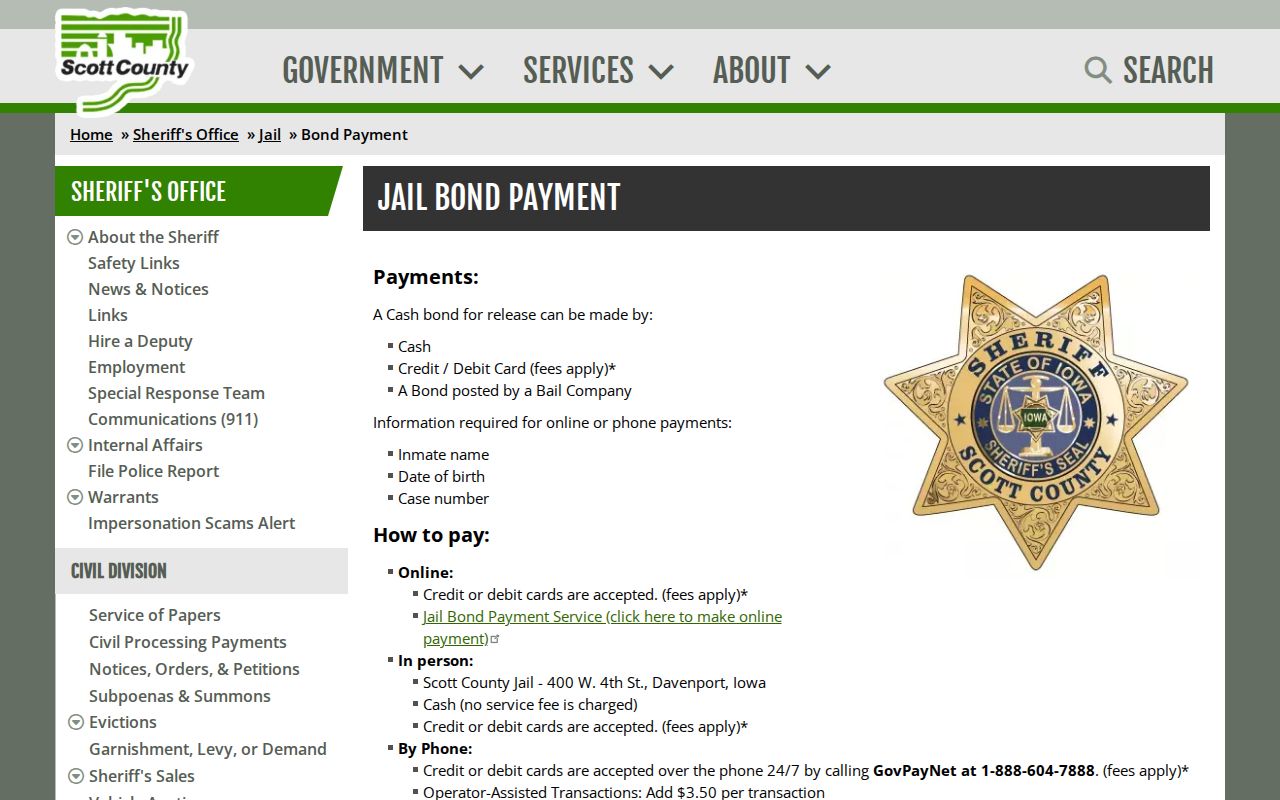
That Scott County bond page lists the approved methods, but the judge's order in the case still sets the release terms.
Handling an Arrest Warrant in Your Name
Start with the Scott County Sheriff page. Record the as-of time, issue date, status, charge, and warrant identifier. Next, search Iowa Courts Online for the matching public Scott County case. Then call the Clerk, the Sheriff, or an attorney to confirm the arrest warrant is current and to learn which judge issued it. A same-name match proves little. A vanished row settles nothing. The Scott County Sheriff FAQ explains voluntary surrender at the Clerk's Office on the courthouse first floor, Monday through Friday from 8:00 to 9:00 a.m. The clerk pulls the case. A bailiff escorts you. The warrant is read, a judge decides release or remand, and the Sheriff advises having bond funds ready since it promises no release.
- Confirm the match and current status through an official source.
- Ask an attorney about surrender, bond, and any motion to recall or quash.
- Use the Clerk’s instructions for the case and appearance time.
- Bring the correct case information and use only approved payment channels.
- Check the docket after appearance for the warrant return and next court date.
Important: Speak with counsel before surrender, and do not assume a payment, search result, or phone call resolves an active arrest warrant.
Scott County Arrest Warrant Safeguards
Watch for scams. The Iowa Judicial Branch warned in June 2026 about fake warrant and fine demands. Real courts never demand payment by text or phone. They do not ask for prepaid money cards, Bitcoin, Social Security numbers, or an unofficial link. Law enforcement does not collect court fines. End the contact and reach the Clerk through a known official Scott County number. For a county administrative record, the Scott County open-records channel works under Iowa Code chapter 22. Define the record, the office, and the date range. Reasonable costs may apply. Protected data can be redacted or withheld. Judicial records go the court route instead, through the Clerk and the Iowa Judicial Branch request channel. Public access never licenses copying a person-level warrant list, and the Scott County Sheriff warns that records change and must be confirmed with the responsible office.