
Scott County Warrant Checks
The place to begin is the Scott County Sheriff warrant search, a limited public snapshot of warrants held by law enforcement agencies in the county. Search a name broadly. Then narrow it. A warrant term, a charge, a date range, a status choice, and a sort order all trim the display. A blank result does not certify that a person has no warrant. One source alone is never enough, so pair the search with the state court case search and the Clerk. Have the full name ready, plus any case or citation number. A same-name match is not proof of identity. If a possible match concerns you, talk with an attorney before you act on it. That is the sound way to run a Scott County warrant check.
- Search the Sheriff's page by part of a first or last name, then narrow the result with dates, charge text, or status.
- Record the as-of time, issue date, warrant number, charge text, and displayed status without assuming each field is current.
- Use Iowa Courts Online with Scott County selected to locate a related public case or citation.
- Ask the Clerk of Court or authorized law enforcement to verify the order. A county records request can help when the public screens are not enough.
- Discuss surrender, bond, or a court filing with counsel if the warrant is confirmed.
Scott County Search Limits
The Sheriff's public list covers a defined window. Its notice says the dataset holds active warrants issued from 18 months to 7 days earlier, plus served or disposed warrants from the prior 30 days. So an older-record boundary and a recent-record gap both exist. The display also shifts over time, which makes the as-of stamp matter more than any copied count. The Sheriff warrant landing page states these limits plainly and introduces the Scott County tools.
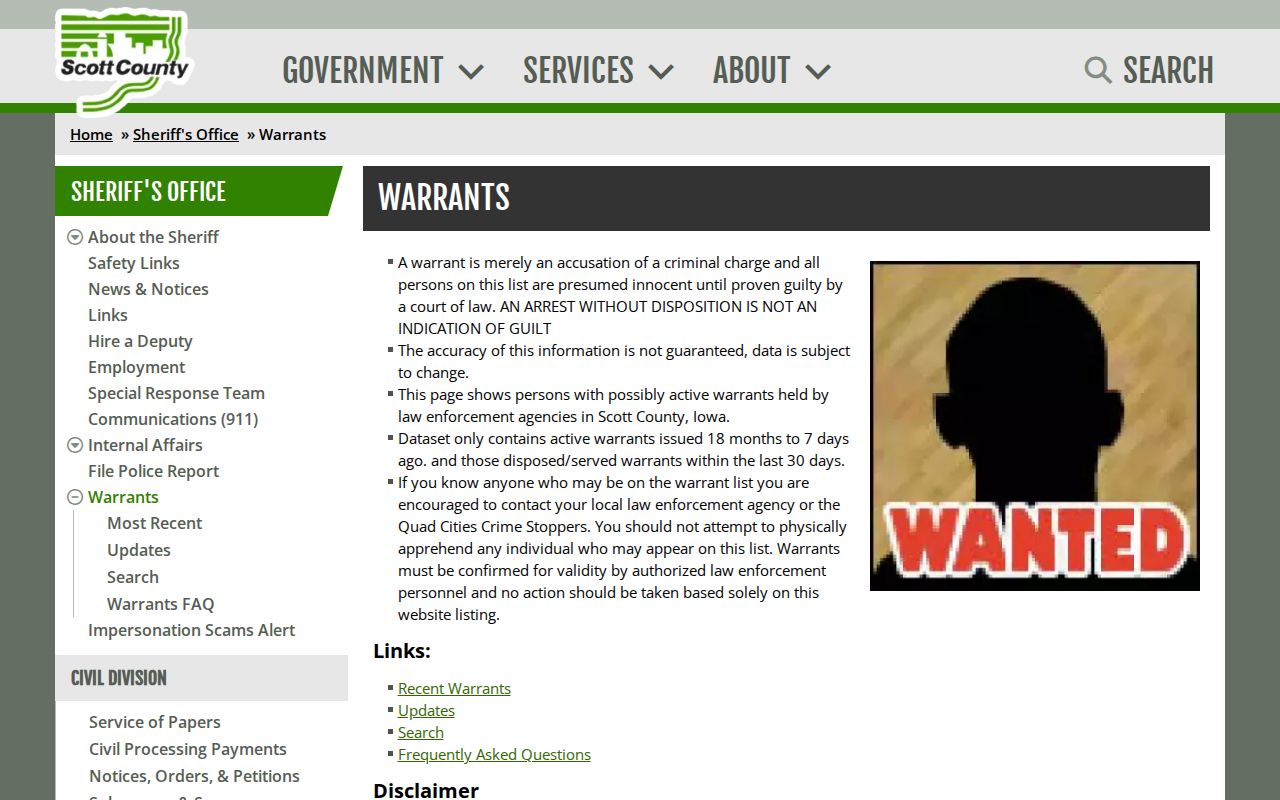
That Scott County landing page routes readers to the search, recent records, updates, and the Sheriff's FAQ. Each link answers a different question.
Key limit: A blank Scott County search is not statewide clearance and does not cover sealed, juvenile, federal, city-only, older, or newly issued process.
Scott County Warrants: Main Types
Scott County warrant records can grow out of a complaint supported by probable cause, a missed appearance, or another judicial order. The label matters. A citation, a summons, a civil municipal infraction, and an arrest warrant do not all authorize the same action. The current court entry controls.
| Record type | How it arises | Issuing authority |
|---|---|---|
| Arrest warrant | A complaint and affidavit or other charging process establishes probable cause. | An Iowa judge or magistrate |
| Bench warrant | A person may miss court or fail to follow an order. | The judge handling the case |
| Search warrant | Probable cause supports a search for specified evidence. | An authorized judicial officer |
| Failure-to-appear warrant | A willful failure to answer a citation can trigger Iowa Code section 805.5. | The court, routed through the clerk and agency |
A capias directs custody in certain criminal or post-charge settings. Scott County publishes no separate capias portal. So go by the exact term on the docket, and do not treat every capias as a bench warrant.
Scott County Portal Fields
The advanced Sheriff search can start from a name fragment or a detail printed on a notice. Broader text returns more possible matches, while dates and charge text cut the noise. The controls do not verify identity or status.
| Field | Use | Important limit |
|---|---|---|
| Name | Any part of a first or last name | Same-name collisions remain possible |
| Warrant | Search a known term or identifier | A partial or mistyped value can miss the row |
| Charge | Narrow by charge or statute text | The short label is not the full complaint |
| Date From / To | Limit the issue-date range | The dataset has its own time window |
| Status / Sort | Filter and order the display | Status still needs confirmation |
The advanced warrant screen documents those controls.
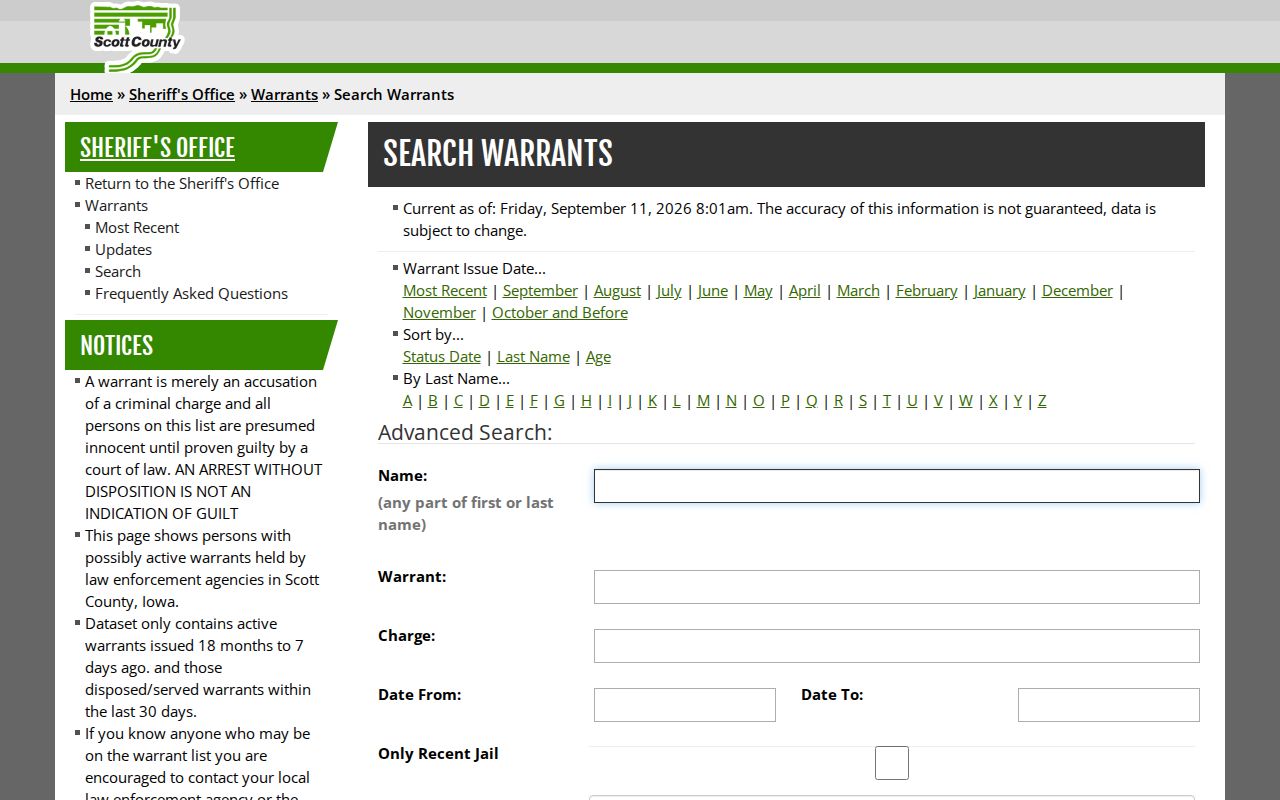
What stays public is the form and its notice, not the personal data in live results. The focus stays on access and process in Scott County.
Scott County Records: What They Show
A displayed row is a compact law-enforcement record, not the whole court file. It can help locate the right case. Each field still needs context from the Sheriff, the Clerk, or the underlying docket. Personal demographic values add little to a process check.
| Warrant number | An agency identifier used to distinguish the process; copy it exactly when requesting verification. |
|---|---|
| Name | The listed subject in last, first, and middle order; it does not prove identity by itself. |
| Issue date and time | When the warrant record was issued, which differs from its later status date. |
| Charge or statute | A short description that should be checked against the complaint and current docket. |
| Bond | An amount may be displayed, but the court's current order controls whether and how bond applies. |
| Status | Active, served, disposed, updated, or a custody indicator may appear and still require confirmation. |
Do not assume "served" closes the related case. It describes only the warrant step, while hearings, release terms, or charges may continue on the Scott County docket.
Scott County Status Changes
The active list and the updates view are not two versions of one list. The active and recent interface for Scott County browses by issue month, alphabet, and sort choice, and it carries an as-of stamp plus a public-service warning.
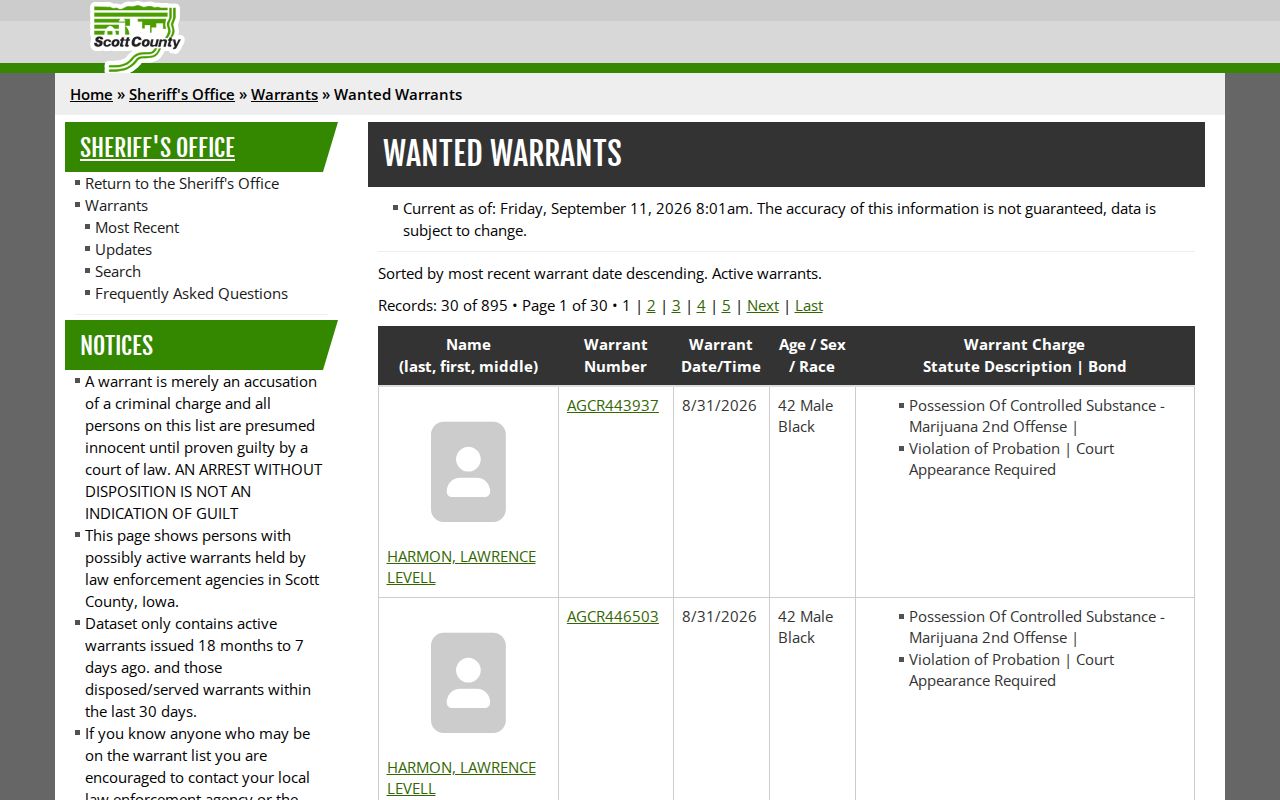
Any result there is tied to one screen and one moment. The updates view is labeled for recently updated non-active records in Scott County.
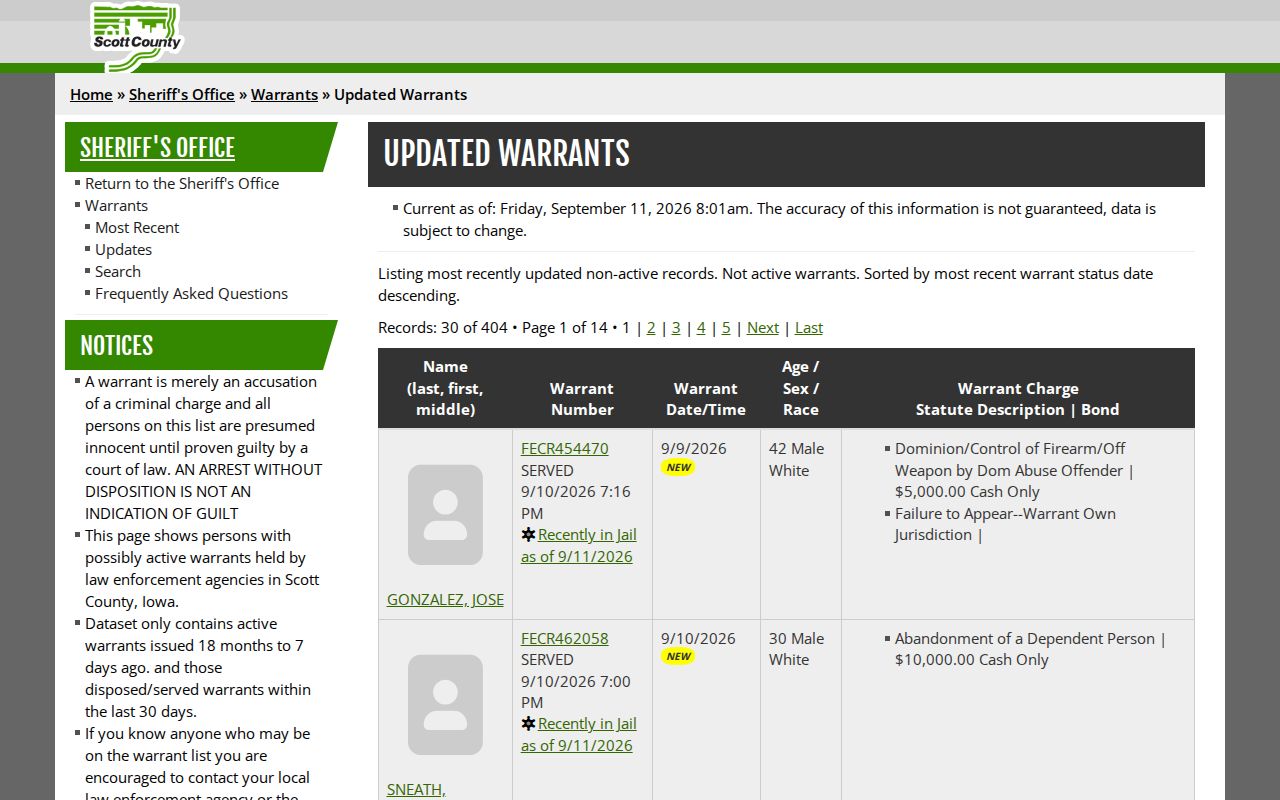
A record on that updates screen is not an active-warrant finding. It may reflect service or another status change.
- Active
- Treated as active in the displayed dataset, subject to confirmation.
- Served
- Reported as executed, though the case may continue.
- Disposed
- The warrant record is non-active; this does not define the whole case.
- Updated
- A status change placed the row in the non-active update view.
Scott County Warrants: Who Does What
A judge or magistrate issues the judicial process. The Scott County Clerk of Court then files and maintains the state court record. The Sheriff and other peace officers execute lawful warrants within their authority, and the Sheriff's website displays a selected public snapshot. Calling that web list the official court record mixes up three separate roles. Scott County sits in Iowa Judicial District 7, where magistrates and district associate judges handle much of the lower-level criminal and traffic work within the District Court structure. Iowa keeps no separate Scott County justice-of-the-peace portal. Municipal infractions go through the district-court clerk instead.
Scott County Court Record Route
Iowa Courts Online searches public state case and citation information by name or by a complete case or citation number. Pick Scott County and the right case type. A name search needs at least two characters from both the first and last names. More characters sharpen the result. The help material expects a full 17-character case ID for that method. The state screen leaves out confidential, juvenile, and restricted matters, and it warns that online information is not the official court record. Older files, service returns, exhibits, some bond information, and schedules may call for the Clerk or a courthouse public terminal. City parking tickets can sit outside this system entirely, so a Scott County warrant check may need a second stop.
| Question | First source | Confirm with |
|---|---|---|
| Is a public warrant row current? | Sheriff warrant search | Sheriff, Clerk, or attorney |
| What case produced it? | Iowa Courts Online | Clerk or court file |
| Is someone in custody? | County inmate listing | Jail or committing agency |
| Is the matter federal? | Southern District docket | Federal clerk or attorney |
Handling a Scott County Warrant
Start by confirming the record is really yours and still active. A Scott County warrant that looks live on a search screen may have been recalled, or it may belong to someone with a similar name. An attorney can pull the case, call the court, and advise whether voluntary surrender, bond, or a motion to recall or quash fits. Only a judge can withdraw a warrant. No search tool does that.
The Sheriff warrant FAQ lays out a weekday surrender window from 8:00 to 9:00 a.m. at the first-floor Clerk's Office. The clerk pulls the file, a bailiff walks you to a waiting area, the warrant is read, and a judge then decides release or remand. Release is never guaranteed at that hearing.
Important: Talk with an attorney and confirm the live court instructions before surrendering, posting bond, traveling, or relying on an online status.
Scott County Bond and Payment
Iowa's Uniform Bond Schedule gives reference amounts for certain non-forcible offenses when court is not in session, but a judicial officer can set other terms and is not bound by the schedule after appearance. Treat any bond figure on the Sheriff's page as unconfirmed until you check the current order.
The Scott County Jail bond page lists the ways to post: cash in person, card in person, online, or by phone with service fees, plus bail-company posting. Online and phone processing need the inmate name, date of birth, and case number. Paying is not the same as clearing the warrant.
Fines work differently. The Iowa payment page warns that payment can operate as a guilty plea. Ask the Clerk or your lawyer whether a court appearance or warrant order still needs action first.
Iowa Law and Scott County Records
Iowa Code chapter 22 opens the door to public records held by government bodies. It does not make every warrant, juvenile file, or court document fully public. The lawful custodian can withhold confidential portions and redact protected data, and separate court rules and statutes govern judicial records in Scott County.
Key rules:
Iowa Code sections 804.1 through 804.4 set the complaint, probable-cause, warrant-content, bond-endorsement, and execution framework.
Iowa Code section 805.5 addresses willful failure to appear after a citation and the resulting warrant process.
Iowa Code chapter 22 governs public-record access, charges, response, redaction, and confidentiality.
Iowa Code section 232.147 protects juvenile records from ordinary public access.
Access to Scott County records is not permission to republish a live roster. Use the official source, describe the fields, and leave names, photos, and personal identifiers off the page.
Scott County Records Requests
When online pages fall short, the Scott County open-records route reaches the right county custodian. The form is recommended, not required. A strong request names the agency, record type, date range, and preferred format rather than asking for a vague sweep of every system. The county aims to respond within ten business days of receipt. It sets a charge of 25 cents per page for requests of ten pages or more and permits a charge for extensive searches beyond 30 minutes, and the custodian may still redact confidential material.
For a state court case, start with the Clerk. An administrative judicial record may go through the state request route. If the goal is understanding a system's fields, ask for a data dictionary or blank schema rather than personal rows.
Scott County Warrant Scams
In June 2026 the Iowa Judicial Branch warned about calls and messages claiming a warrant or fine must be paid at once. Real court communications never demand payment by text or phone, prepaid card, Bitcoin, a supplied unofficial link, or a caller's private number. Law enforcement does not collect court fines. Hang up and dial a number from an official court page. The state scam warning points people to the Clerk or the secure state payment route to verify. A threat of arrest is a reason to slow down, save the message, and check the real case record.
To report another person, never approach or try to detain anyone. Call local law enforcement or Quad Cities Crime Stoppers instead. A tip line cannot confirm or resolve a Scott County warrant of your own.
City Warrant Records in Scott County
Davenport, Bettendorf, Eldridge, Blue Grass, and Durant all fall under Iowa's state District Court structure, though their police departments handle city-originated reports and some citations. None of the five runs a public city warrant portal. Begin with the Scott County Sheriff and Iowa Courts Online, then contact the city agency when the question concerns its own record. Durant needs extra care, since it spans Scott, Cedar, and Muscatine counties.
Davenport Warrants
2020 population 101,724 · Police records and city civil citations use distinct routes.
Bettendorf Warrants
2020 population 39,102 · Verify police contacts on the live official page.
Eldridge Warrants
2020 population 6,726 · The city contact form is not a warrant database.
Le Claire Warrants
2020 population 4,710 · Routine police contact is separate from emergency service.
Durant Warrants
2020 population 1,871 · Identify the filing county before searching.
Federal Warrants Near Scott County
A federal case tied to Davenport belongs to the United States District Court for the Southern District of Iowa, not the Iowa District Court for Scott County. The federal Davenport location and PACER can supply public docket information when a filing is open, but neither offers a universal public warrant-status search. Sealed or unexecuted process may not appear at all. The U.S. Marshals Service's Southern District of Iowa task force is an enforcement partnership, not a self-search database. Ask the federal clerk or an attorney about a federal matter.
Do not read federal status into an absent county result, and do not assume a county listing settles a federal question. County, city, state, and federal sources overlap in geography, not authority. Identifying the court and agency first keeps a Scott County warrant search out of the wrong system.