
Inside the Scott County Most Wanted Program
Scott County's official sources show two related but distinct public-safety channels. The Scott County Sheriff's warrant site provides the county's searchable, limited snapshot of possibly active warrants. Crime Stoppers of the Quad Cities accepts anonymous information for law enforcement. Neither source is the court order itself, and Crime Stoppers is not the Clerk of District Court.
No verified current official page containing a dedicated Scott County most-wanted roster was confirmed in the research. This page therefore describes and links the verified government and program sources only. It never republishes names, photographs, mugshots, addresses, or a roster. That approach keeps changing information with the responsible publisher and helps prevent an old copy from being mistaken for a live warrant or active alert.
Scott County Wanted Alerts Are Selective
A wanted alert is selective public communication, not the full universe of Scott County court process. An agency may highlight a matter because investigators seek timely public information. That editorial choice does not create the warrant, determine guilt, or supply the final status. A judge or magistrate issues legal process, the Clerk holds the connected case record, and authorized law enforcement confirms whether it remains enforceable.
Key distinction: Selected publicity concerns public assistance; warrant verification concerns the current court and law-enforcement record.
Absence from an alert proves nothing about whether a warrant exists. Presence in an old post also cannot establish that process remains active today. Use the alert for its stated public-safety purpose, then use the Sheriff, Clerk, or issuing court for status questions.
How Scott County Most Wanted Lists Work
Most-wanted material is generally a selected appeal for information, while the Sheriff's active interface is a broader search with its own date and agency limits. The Scott County search states that it displays possibly active warrants held by law-enforcement agencies in the county. Its active window covered issue dates from 18 months to seven days earlier during research, plus served or disposed updates from the prior 30 days. A recent warrant or older active process can fall outside that public window.
An arrest, surrender, recall, service, or other court action can change status. The Sheriff's separate updates view contains recently updated non-active records and expressly says they are not active warrants. Public pages can update at different times, so the court docket and authorized agency confirmation remain essential.
Note: Every Scott County wanted or warrant page is a dated snapshot; presence or absence alone does not establish current legal status.
Scott County Most Wanted Tip Program
A government-hosted Crime Stoppers program document describes a cross-river service area covering Scott County, Iowa, and Rock Island County, Illinois. The program is funded by private donations and operated with a volunteer board. It works with media partners to distribute public information and accepts tips for investigators.
Crime Stoppers is not a warrant search, court clerk, payment office, surrender desk, or federal fugitive database. A tip goes toward an investigation. It does not give the caller a legal status determination about themselves or another person. The document reports program-level impact information, but such figures should describe the program, not be turned into claims about current Scott County warrant volume.
- Anonymous tip
- Information submitted through the program without using a routine personal contact channel.
- Reward
- A conditional program payment, not bond, bail, a court fine, or a fee for warrant confirmation.
- Official status
- The current answer supplied by the responsible court or authorized law-enforcement agency.
Sending a Most Wanted Tip Safely
The program document identifies three anonymous routes: its telephone channel, the P3 Tips mobile app, and its website. Use the current official program material to select a route because contact details and app instructions can change. Give relevant observations, location, timing, or other facts without confronting, following, or trying to detain anyone.
- Open the current official Crime Stoppers phone, P3 Tips, or website instructions.
- Report concrete facts such as place, time, direction of travel, or a safety concern.
- Keep the program's tip reference so follow-up does not require revealing an identity.
- Step away and let law enforcement decide how to respond.
Key Point: Submit information and step back. Never approach, pursue, restrain, or try to apprehend a person mentioned in an alert.
Scott County Most Wanted Reward Terms
The official program document describes a cash reward of up to $2,500 when information leads to a felony arrest. The words up to and leads to matter. This is a stated ceiling with a condition, not a guaranteed payment for every message, identification, warrant, or arrest. Current program rules govern eligibility and follow-up.
A reward has no role in a person's bond or court balance. Bond concerns possible release and judicial conditions. A fine is a court obligation. A Crime Stoppers reward concerns useful information under program rules. Keeping these terms separate helps readers avoid scam demands and false promises.
How Most Wanted Differs From an Active Warrant
Most-wanted publicity asks the public for help on selected matters. An active warrant is judicial process that may await service, surrender, recall, or another official status change. Many warrants never become featured alerts, and an old alert may remain visible after legal status changes.
| Feature | Most Wanted List | Active Warrant |
|---|---|---|
| Purpose | Selected public appeal for information | Court process authorizing arrest or detention |
| Publisher | Law enforcement or a tip program | Issued by a judge; displayed by an agency when public |
| Coverage | A small, selected set | Broader universe, though no public search is complete |
| Correct action | Report safely without intervening | Verify with counsel, court, Clerk, or law enforcement |
Scott County Warrant Tips Are Not Verification
Crime Stoppers routes information to investigators. It cannot clear a name, authenticate a warrant, interpret a docket, collect a fine, schedule court, or promise a reward. For the public warrant snapshot, use the Sheriff's official search. For an underlying public state case, use Iowa Courts Online and the Scott County Clerk. For a current legal-status answer, ask the responsible court or authorized law enforcement.
Tip program
Receives public information through anonymous channels and passes it for investigative use.
Sheriff
Publishes a limited public warrant view and warns users to confirm before acting.
Clerk and court
Maintain the underlying public case and current judicial action, subject to access limits.
Federal process is separate as well. The U.S. Marshals Service Southern District of Iowa Fugitive Task Force is an enforcement partnership, not a public self-search tool, and PACER is not a national warrant-status index.
Scott County Wanted Record Publishing
Public access does not require every publisher to duplicate personal data. Scott County's official warrant tool already carries agency warnings, changing status, and a limited display window. Copying its people-level content would detach it from those safeguards and could leave a stale name or image online after the official record changed.
This civic reference therefore stays at the program level. It explains where the official records live, how the systems differ, why dates and scope matter, and where to report information safely. It does not cache, mirror, or build a local most-wanted roster. Readers should also avoid unofficial reposts that lack an as-of time or a clear government source.
The Iowa Judicial Branch public-records request page shows the separate state route for judicial-administration records.
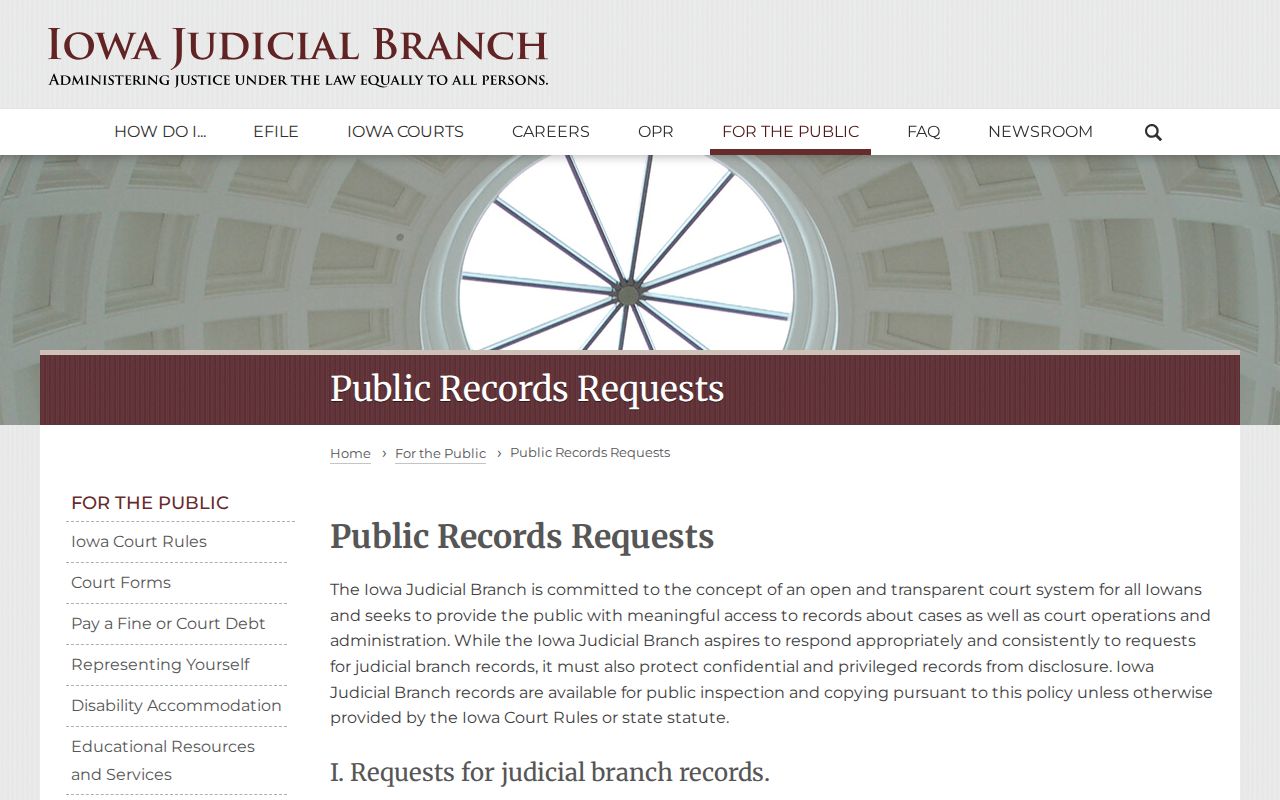
That state channel does not turn confidential court material into a public most-wanted record, and a specific case is usually better addressed through the Clerk.
Iowa Code chapter 22 governs public and confidential records, while juvenile, sealed, and other protected material can remain outside public access. A narrow records request may clarify program policy or non-personal statistics, but it should not be used to assemble a bulk name and photo collection.
When You Believe You Are Listed
Do not use Crime Stoppers to ask about your own legal status. Contact an attorney, the Scott County Clerk of District Court, or authorized law enforcement and ask them to verify the exact process. A lawyer can help identify the issuing court, understand a bond endorsement, and discuss an appropriate appearance or surrender route. Only the court can recall or change its warrant.
The Sheriff's warrant FAQ describes a local voluntary-surrender procedure for a person who believes they are listed and lacks counsel. It directs the person to the Clerk's Office on the courthouse first floor during the stated 8:00 to 9:00 a.m. weekday window. The clerk pulls the case, a bailiff escorts the person, the warrant is read, and a judge may release or remand. This description is not a promise of release or a set bond.
Important: Consult an attorney and verify current process before appearing; surrender, custody, release, and bond decisions remain case-specific.