
How Bench Warrants Work in Scott County
A bench warrant grows out of a duty the court already has in front of it. Think of the usual Scott County triggers: a missed appearance, a willful failure to answer a citation, or a refusal to follow a court order. One route is written plainly in Iowa Code section 805.5. Skip a citation court date on purpose and you can be charged with a simple misdemeanor, and the court can then issue an arrest warrant. Not every late arrival ends that way. Notice matters. So do a reset date, the type of case, and what the docket actually says. Iowa publishes no separate Scott County bench-warrant database. The Scott County Sheriff warrant service posts a selection of warrants held by law-enforcement agencies, while the Iowa District Court for Scott County stays the trial court of record. The court's own order may say bench warrant, arrest warrant, or some other exact term. A capias, too, is an order directing custody in certain settings, though Scott County offers no separate capias portal. Read the docket language itself. Treat none of these labels as automatic synonyms.
Scott County Bench Warrant Citation Dates
A traffic ticket or simple criminal citation often carries the first clue. The Scott County Traffic and Criminal office states that a ticket is due on or before its court date. Its staff handles county criminal and traffic charges, takes in fines and costs, sits in on morning magistrate court, and builds files for the associate and district judges. Ask that office to help you find the file and the schedule. Clerks cannot give legal advice. Begin with the citation in hand. Then run a search on Iowa Courts Online by name or by a full case or citation number. Pick Scott County and the correct case type. The state system leaves out confidential, sealed, and juvenile matters, and city parking tickets never appear there. So a blank result does not prove that no Scott County bench warrant exists.
Myth and fact: A missed date can lead to a warrant, but only the current court record shows what the judge actually ordered.
Bench Warrant Issuance in Scott County
Issuance begins with the underlying case. A citation, complaint, information, indictment, or similar filing opens the matter. When the record shows a failure to appear or some other duty left unmet, a judge or magistrate reviews the file and decides what process the law allows. In citation cases, Iowa Code section 805.5 sends a willful failure-to-appear warrant through the clerk and the issuing agency. The Clerk files and keeps the judicial record. Law enforcement takes the process and executes it. Those roles never blur. A judge issues the Scott County bench warrant. The Clerk of Court maintains the case. The Scott County Sheriff or another authorized peace officer may serve it. Remember that the Sheriff's web list is only a display of selected law-enforcement-held data, not the official court order. Once service occurs or another status event takes place, the agency records the return, and the clerk's file shows what the court did.
Missed date → judicial review → warrant issuance → clerk filing and agency routing → service, appearance, or recall → docket and public-display update.
Scott County Bench Warrant Search Limits
The Sheriff's advanced warrant search lets you enter any part of a first or last name, warrant text, charge text, a date range, status, sort order, and a recent-jail control. Alphabet links and issue-month groupings make the public interface easier to browse. The notice on the page matters as much as the fields. The active dataset holds warrants issued from 18 months to 7 days ago, and disposed or served records from the prior 30 days. That leaves two gaps. A brand-new bench warrant can sit inside the seven-day delay, while an older active warrant can fall outside the 18-month window. The separate updates view holds recently updated non-active records. It is not a second active list. Read the page's as-of time and status every time, then confirm through the clerk's docket or an authorized agency.
| Channel | Best Use | Key Limit |
|---|---|---|
| Sheriff search | Current public county snapshot | Limited date windows and changing data |
| Iowa Courts Online | Underlying public case or citation | Not a direct warrant check |
| Clerk or public terminal | Current court record and documents | Restricted files stay unavailable |
| Chapter 22 request | Ask the proper county custodian | Fees, redactions, and lawful withholding may apply |
Note: Scott County publishes no dedicated public warrant hotline and no separate city bench-warrant portal.
How Bench and Arrest Warrants Differ
Both kinds of process can authorize an arrest, but they start in different places. A bench warrant answers a duty in a case already before the court. An arrest warrant under Iowa Code chapter 804 usually starts with a complaint and a supporting affidavit that establish probable cause to a neutral judge or magistrate. A summons just tells a person to appear and does not authorize an arrest by itself. The precise order controls. The shorthand label on a public list does not.
| Feature | Bench Warrant | Arrest Warrant |
|---|---|---|
| Typical Trigger | Missed appearance or unmet court duty | Probable cause supported by complaint and affidavit |
| Issued By | Judge or magistrate in the case | Judge or magistrate after neutral review |
| Purpose | Bring the person before the court | Authorize custody on an alleged offense |
| Next Step | Confirm, appear, and ask about recall | Confirm, seek counsel, and plan surrender or bond |
Scott County Bench Warrant Status Words
A Scott County warrant result may carry short status words that describe only the agency display, not the whole case. The Sheriff warns that its list can change and may contain errors. A matching name proves nothing about identity. Treat the issue date, charge description, bond field, and case details as clues to verify, not as the answer.
- Active
- The displayed dataset treats the warrant as active; law enforcement must confirm it.
- Served
- The process was reportedly executed and may appear briefly in recent updates.
- Disposed
- The warrant record is non-active, though the underlying case may continue.
- Recalled or quashed
- The court has withdrawn or set aside the process; verify the signed order and current docket.
- FTA
- Failure to appear, which may lead to process under Iowa law when statutory facts are met.
The bond shown is no promise of release. A Scott County judge can set or change conditions, so confirm the current order before paying anything.
Clearing a Bench Warrant in Scott County
Confirmation comes first. Gather the case or citation number if you have it, check the public case file, and call the Scott County Clerk of Court or an attorney. Ask what the order requires. Ask whether bond is set, whether a new date is available, and whether counsel should move to recall or quash the warrant. Recall means the court withdraws the warrant; quash means it sets the warrant aside. Trust neither result until the record confirms it.
- Check the Sheriff’s current snapshot and note its date and status limits.
- Find the underlying Scott County case or citation in Iowa Courts Online.
- Confirm the bench warrant with the Clerk, Sheriff, or an attorney.
- Ask counsel about recall, quash, appearance, surrender, and bond options.
- Complete every court step and verify the final docket status.
Scott County also offers a voluntary-surrender route, spelled out in the Sheriff warrant FAQ. Show up at the Clerk’s Office on the courthouse’s first floor, Monday through Friday from 8:00 to 9:00 a.m. The clerk pulls the case. A bailiff then escorts you to a waiting area, the warrant is read, and a judge decides release or remand. None of that guarantees release. Paying online is different. The Iowa Judicial Branch warns that such payment can act as a guilty plea. A receipt alone does not prove the Scott County bench warrant was recalled. Ask the clerk to confirm warrant status and every remaining appearance duty.
Act carefully: Speak with an attorney before surrender, and never assume a payment or vanished web result cleared the court order.
Scott County Bench Warrant Bond
If the judge remands someone to custody, the current order controls bond. The Iowa Uniform Bond Schedule offers reference amounts for certain non-forcible offenses when courts are closed. It is not a fixed Scott County bench-warrant price list. Judicial officers are not bound by it after appearance. The Scott County Jail bond page explains the cash, card, and bail-company options and the case details each payment needs. Use the official page only. Bring the current case number and the current order. A scammer demanding prepaid cards, Bitcoin, or payment by text or phone is not following the Judicial Branch’s process. The statewide scam warning is blunt. Law enforcement does not collect court fines. Hang up. Contact the Clerk through a known government page. That quick check protects both the case and the person’s funds.
Scott County Bench Warrant Scam Checks
Fake bench-warrant calls thrive on arrest threats. The Iowa Judicial Branch scam warning lists the tells. Real court communications never demand payment by text or phone, prepaid money cards, Bitcoin, a Social Security number, or an unofficial link. Law enforcement does not collect court fines either. A caller’s urgency is not proof of a Scott County bench warrant. Hang up without sharing data or sending money. Find the Scott County Clerk number on the official court page, search the public case source, and ask the office to confirm the file. An attorney can verify the order and discuss a safe response. Save 911 for true emergencies, not warrant research.
Scott County Courts That Issue Bench Warrants
Bench warrants in Scott County come from one place: the Iowa District Court for Scott County, the local state trial court. Its bench includes district judges, district associate judges, and magistrates. Scott County sits in Judicial District 7. The main courthouse is in Davenport. No justice-of-the-peace, town, or municipal warrant court exists here. Iowa Code section 364.22 treats a municipal infraction as a civil citation routed to the Clerk of District Court, not a city criminal-court database. For warrant questions, start with the Scott County Clerk of Court at 400 W. 4th Street, Davenport, Iowa 52801. The office number is 563-326-8647. Have the full name, date of birth, citation or case number, suspected court date, and any warrant identifier ready. Ask which judge or magistrate issued the process. Ask what the current docket says. The official Scott County courts page maps each court office and its role.
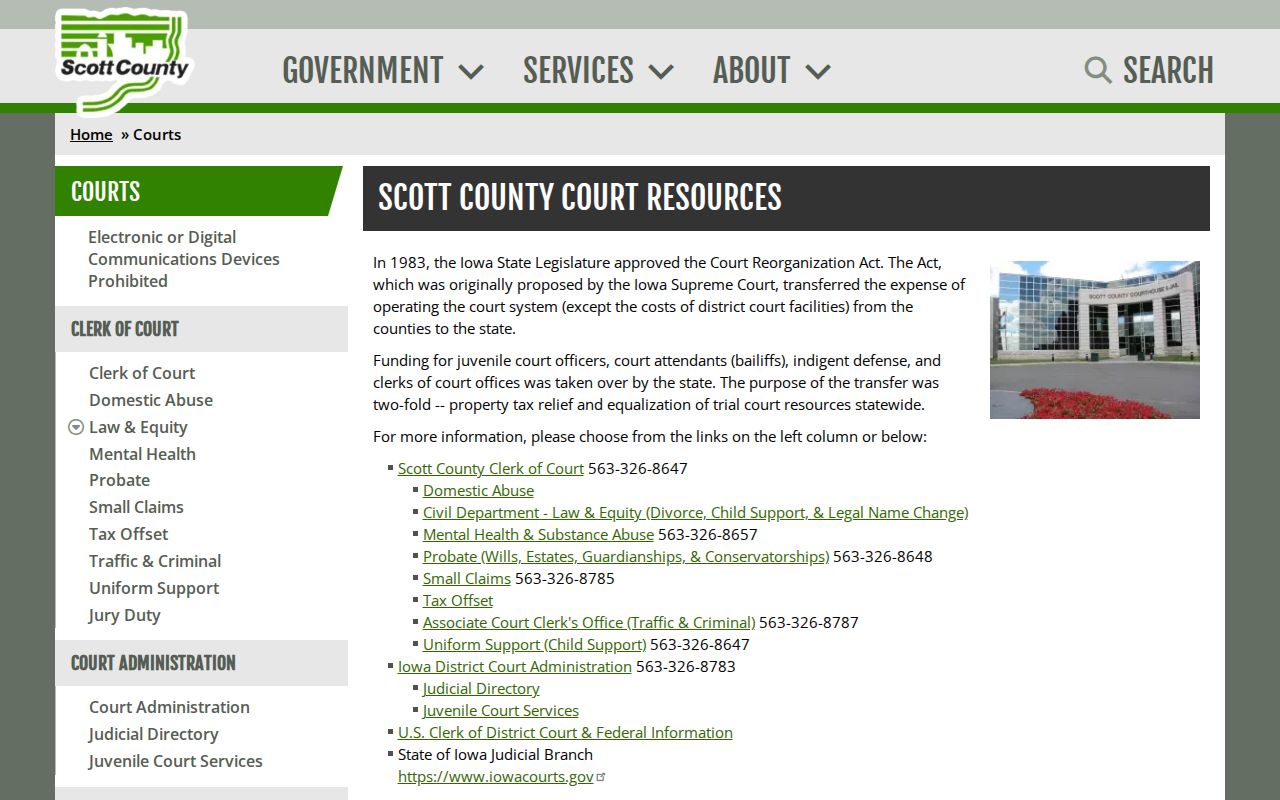
The Scott County courts page separates state court and clerk functions from county administration and Sheriff enforcement.
Scott County Clerk of Court
400 W. 4th Street
Davenport, IA 52801
563-326-8647
Current case record, court schedule, and issuing-court confirmation.
Scott County Sheriff
400 W. 4th Street
Davenport, IA 52801-1104
563-326-8625
Public warrant snapshot and law-enforcement verification route. Office hours are Monday through Friday, 8:00 a.m. to 4:30 p.m.
County records outside the court file follow a different path. The Scott County open-records route takes requests under Iowa Code chapter 22. Name a specific record and date range. The office may charge reasonable costs, redact protected data, or withhold a confidential record; court files are better checked at a courthouse public terminal or through the Clerk.